
Start Your Career in Social Media Marketing
Social media is one of the fastest-evolving fields in digital marketing, influencing public opinion, building brands, and connecting people worldwide.
It’s also widely misunderstood — both incredibly powerful and uniquely demanding.

Page Contents:
“Social media professionals aren’t just posting memes. They manage strategy, reputation, crisis response, content creation, analytics, and community interaction — often across multiple platforms every day.”
– Jennifer Radke, National Institute of Social Media
What is Social Media Marketing?
The term “social media” itself was coined in 2004, but its spirit: community-driven communication has existed for centuries. From 1980s bulletin boards to modern meme culture, social media reflects how humans organize, share, and influence.
Understanding this historical and functional context helps professionals think beyond platforms and focus on the role social media plays in shaping relationships and decisions.
Why Social Media Marketing Is a Career Worth Pursuing
In today’s digital-first economy, social media is one of the most powerful, public-facing, and fast-evolving career paths available. From campaign strategy and brand building to crisis response and customer engagement, social media marketers play a vital role in shaping how companies are seen and experienced.
This isn’t just a “fun” job. It’s a critical business function; one that blends creativity, psychology, analytics, and leadership. Whether you’re just starting your career or looking to specialize in digital marketing, this guide will help you explore what it takes to thrive in social media marketing.
As this field continues to mature, it offers real opportunities for career growth, creative expression, and strategic impact. But it also comes with unique pressures — and it’s not for the faint of heart. For those who are curious, resilient, and quick to adapt, social media offers one of the most versatile and rewarding paths in digital marketing.
From our Course: The Art & Science of Content Marketing
“If you’re going to work in social, you have to accept that the rules will change while you play the game.”
What do Social Media Marketing Professionals Actually Do?
It’s easy to think of social media marketing as simply “posting content,” but the real job is far more complex. Today’s social media professionals are responsible for strategy, messaging, engagement, reputation, and measurable performance, often across multiple departments and stakeholders.
The job demands the speed of journalism, the diplomacy of PR, the creativity of advertising, and the analytical skills of data science.
In smaller organizations, a social media manager might do everything: content creation, customer response, reporting, and even video editing.
In larger organizations, roles become more specialized, making collaboration while managing projects and teams essential.
Regardless of company size, these professionals are always navigating shifting expectations, not just from their audiences, but from leadership who may not fully understand the work’s scope or value.
Typical Social Media Marketing Work
Community participation (comments, likes, shares)
Content threading (visible public conversation trails)
Many-to-many communication (not just brand-to-audience)
Rapid change and adaptation (tools, formats, rules, and trends shift constantly
Social Media is Bigger Than Just “Marketing”
Social Media is a cultural force that has redefined how organizations communicate. For marketers, brand managers, and executives, social media now touches every part of strategy and execution.
For Marketers:
- It demands agility, speed, and creativity across platforms.
- Social content fuels campaigns, testing, customer feedback, and insights.
- Real-time performance requires daily (sometimes hourly) monitoring.
For Brand Managers:
- Social is the front line of brand reputation.
- Brand voice, accessibility, and responsiveness must be consistent and human.
- Social platforms can amplify praise or criticism within hours.
For Communications Professionals:
- Social media overlaps with public relations, crisis comms, and internal messaging.
- A single viral moment (positive or negative) can define public perception.
- Platforms like LinkedIn and X (Twitter) now host policy discussions and press briefings.
Social Content Variety Influences Campaign Tactics
Social media platforms are not interchangeable. Each has its own formats, limitations, strengths, and audiences.

TikTok
Short-form video, trend-driven. Used for youth engagement, viral content.

Visual storytelling, brand engagement, influencer collabs

Community and advertising. Local engagement, paid distribution.

YouTube
Long-form video and quick Shorts. Education, entertainment, and reviews

Blogs
Depth & control of message. SEO, evergreen content, and authority.
Social Media Professionals must match audience intent with platform capability, and they must be ready to adapt when platforms change priorities.
The Challenges of Social Media
Despite the fun and creativity, social media work is demanding. It’s one of the few marketing roles that deals directly with the public — unfiltered.
Few roles in marketing are as publicly exposed — or as misunderstood — as social media. This job isn’t just about engagement rates; it’s about reputation, responsiveness, and resilience. Social media managers face pressure from the outside (angry customers, trolls, crises) and the inside (unclear expectations, vague success metrics, poor staffing). Many report high rates of burnout and difficulty unplugging from work.
Unfortunately, many executives have little knowledge of what social media work entails. A post may take hours to create, edit, and adapt for multiple platforms — not to mention accessibility compliance and performance tracking. Without clear support, social media professionals can be undervalued and overwhelmed. That’s why mental health, clear scope, and team structure must be treated as strategic priorities — not afterthoughts.
Common challenges include:
- Working across too many platforms with too few resources
- Dealing with trolls, misinformation, and disinformation
- Feeling pressure to be “always on” — leading to burnout
- Managing leadership expectations around ROI
- Responding to negative comments or crises in real-time
- Constantly chasing shifting platform algorithms and rules
“You have to be calm in chaos. Social media managers aren’t just marketers — they’re frontline responders, brand protectors, and community builders.”
– Jennifer Radke, National Institute of Social Media
The Skills You’ll Need to Succeed
To succeed in social media marketing, professionals must blend right-brain creativity with left-brain discipline. But perhaps most important is the ability to remain calm and focused in the face of uncertainty:
Algorithms change.
Platforms shift.
Crises happen.
A decision maker won’t buy in.
Success comes from strategic thinking, adaptability, and self-awareness.
Beyond tactical know-how, great social media pros have thick skin and soft hearts. They need empathy to handle sensitive conversations, and judgment to know when to engage – or not.
Mental health is a real concern in this profession, especially when managers are exposed to online hostility, feel pressure to be “always on,” or are expected to monitor platforms 24/7. Organizations must do more to support these professionals, and individuals must learn to protect their own well-being.
Essential Social Media Marketing Skills:
- Writing and storytelling
- Basic graphic or video editing
- Audience Research
- Understanding audience behavior and platform culture
- Knowledge of social algorithms and formats
- Proficiency in tools like Canva, Hootsuite, Sprout, or Buffer
- Analytics: Strategy, insights, and communication
- Crisis management and online diplomacy
- Time management and prioritization
Soft skills like patience, resilience, and tact are just as important as technical expertise — especially when dealing with public scrutiny or brand emergencies.
What Kind of Training or Education is Needed?
Because social media evolves constantly, learning can’t stop at graduation or a single certificate. While formal degrees in communications, PR, journalism, or marketing can provide a strong foundation, professionals must also pursue ongoing education to stay current with tools, platforms, policies, and best practices.
There’s no single degree required for social media careers, but professional development is non-negotiable.
Common educational paths:
- Marketing, communications, journalism, or public relations degrees
- Certificates in digital or social media marketing
- Hands-on experience managing accounts, even personal or nonprofit
- Continuous learning through webinars, blogs, and platform updates
Leading industry certifications like the National Institute for Social Media (NISM) are becoming industry standards, as they validate strategic skills and platform knowledge.
In addition to platform skills, emerging areas such as accessibility, media literacy, and cybersecurity are now essential. A strong training program should not just teach tactics — it should build long-term strategic thinking and ethical decision-making.

Daily Priorities for Social Media Marketers
A recent Role Delineation Study on Digital Marketers commissioned by the OMPC® (Online Marketing Certified Professional) surveyed practitioners and managers to find the daily priorities for those in digital marketing.
For Social Media Professionals, their day is typically spent:
- Content Strategy and Communication of Practice (13% of hours spent).
- Develop Content for Social Channels (11% of hours spent)
- Reporting Campaign Effectiveness (7.6% of hours spent)
- Monitor Channels (7.3% of hours spent)
- Manage Paid Media & Advertising (7% of hours spent)
- Develop and Implement Lead Generation (5.6% of hours spent)

click for larger image

Education and Certification
While there is no formal degree in search engine optimization, there are a number of self-directed learning opportunities, free and low-cost courses, and higher end certification courses.
This lack of gatekeeping allows for merit-based advancement, but it also creates an uneven landscape where misinformation spreads easily and unqualified individuals claim expertise.
Legitimate, respected options include:
- HubSpot Social Media Marketing Certification – free, beginner-friendly, widely recognized
- LinkedIn Learning – credibility and trusted source, but can be expensive
- eMarketing Institute – ebook. Perfect for beginners
- NISM (National Institute of Social Media) – advanced, if you’re pursuing a professional-grade role
- OMCP – Advanced, for those who desire management roles in digital marketing
Self-taught entry is common, but not sufficient. Employers and clients increasingly expect proof of outcomes. Demonstrable success, whether in traffic, rankings, or conversions, matters far more than academic credentials.
Specialization Within Social Media
Social media isn’t a one-size-fits-all role.
As organizations mature, they must divide responsibilities based on talent, workload, and business goals. A content creator might focus solely on video production or memes, while a strategist oversees analytics, budget, and long-term planning. Some teams assign platform ownership, while others distribute responsibilities by campaign type or department.
Structure often evolves based on necessity and individual talent. Teams of five look very different from teams of fifty. There’s no universal “org chart” for social — and that’s okay. Flexibility, cross-training, and role clarity help professionals grow while preventing burnout and skill gaps.
As brands mature, social media roles are becoming more specialized. Depending on your interests and strengths, you might focus on:

Job Prospects and Career Growth
The job market for social media professionals continues to grow — and diversify. According to LinkedIn’s Emerging Jobs Report, roles like Social Media Manager, Content Strategist, and Influencer Marketing Specialist have shown year-over-year growth, especially in industries like tech, retail, education, and healthcare. As more brands shift budgets toward digital-first strategies, demand for skilled professionals who understand engagement, platforms, and analytics is accelerating.
In-house roles now appear alongside agency jobs, freelance contracts, and hybrid content positions.
Salaries vary widely based on region, company size, and specialization — but social media is increasingly seen as a strategic, high-impact field with upward mobility into brand, content, or digital strategy leadership.
Social Media Job Salaries (U.S. Averages)
| Role | Average Salary/Year (USD | Typical Range/Year (USD) |
|---|---|---|
| Social Media Coordinator | $48,000 | $40,000 – $60,000 |
| Social Media Manager | $70,000 | $55,000 – $95,000 |
| Senior Social Media Manager | $90,000 | $75,000 – $120,000 |
| Content Strategist | $85,000 | $65,000 – $115,000 |
| Influencer Marketing Manager | $75,000 | $60,000 – $100,000 |
| Head of Social / Director | $120,000 | $95,000 – $160,000 |
| Freelance Social Media Professional | $35 – $100/hr (project-based) | Varies by scope & client |
Source: Glassdoor, Payscale, Robert Half 2025 Salary Guide, LinkedIn Salary Insights
Social Media Job Salaries (International Averages)
| Country | Average Salary/Year (USD | Notes |
|---|---|---|
| Canada | $65,000 CAD (~$48,000 USD) | Higher in Toronto & Vancouver |
| United Kingdom | £35,000 GBP (~$45,000 USD) | London salaries closer to £45k–£55k |
| Australia | $80,000 AUD (~$52,000 USD) | Strongest demand in Melbourne & Sydney |
| India | ₹600,000 INR (~$7,200 USD) | Entry roles around ₹300k–₹500k |
| UAE (Dubai) | 144,000 AED (~$39,000 USD) | Often tax-free; perks include housing/relocation |
| Germany | €45,000 EUR (~$49,000 USD) | Higher in Berlin and Frankfurt |
Sources: Morgan McKinley, Hays Global Salary Guide, Glassdoor Global, GulfTalent
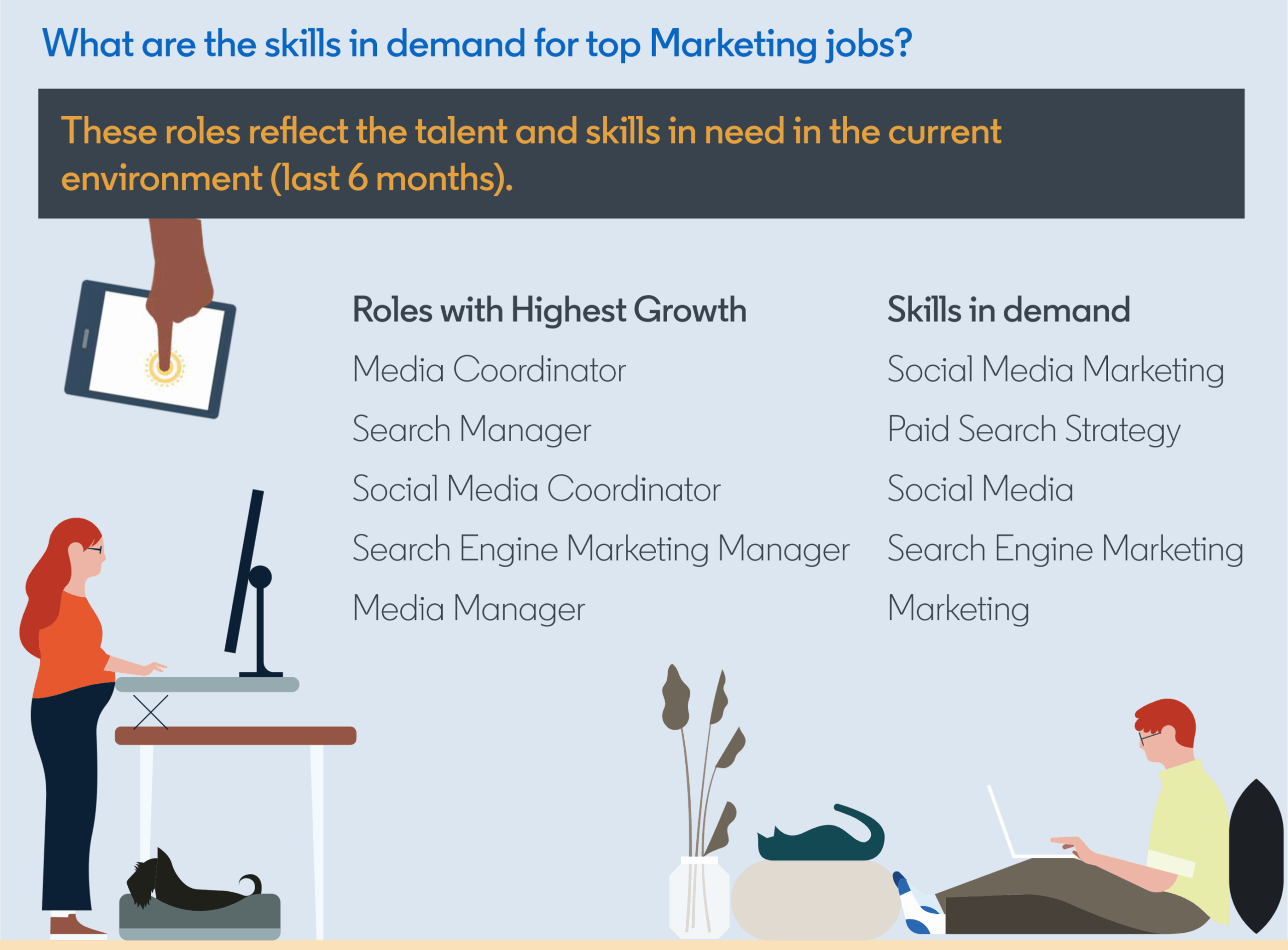
“Whether you’re entering the workforce or pivoting mid-career, social media offers one of the most creative, in-demand, and future-proof marketing paths today.”
– LinkedIn, Top Marketing Skills
Where Social Media Marketers Work: Agencies, In-House, or Freelance?
As you grow your skills in social media marketing, you’ll face an important decision: Where do you want to work? Each career path offers a different experience, work environment, and level of autonomy — and understanding the differences can help you choose a direction that fits your goals and lifestyle.
Agencies
Agency roles involve managing social campaigns for multiple clients across industries. You’ll need to juggle competing timelines, understand different brand voices, and often switch gears multiple times a day. Fast-paced and creative, agency work hones your adaptability and problem-solving skills.
Ideal for: Those who thrive under pressure, love variety, and want to accelerate their learning.
Pros:
-
- Work on a variety of clients, industries, and projects
- Learn rapidly from a team of specialists
- Build a diverse portfolio quickly
- Exposure to multiple marketing disciplines
Cons:
-
- Long hours and demanding timelines
- Pressure from multiple clients at once
- Less control over brand direction or long-term planning
- Must adapt to each client’s preferred tools and systems
In-House, Brand or Company
In-house roles mean you’re working directly for a single company, managing its social presence and aligning closely with its internal departments like marketing, sales, PR, and customer service. You become part of the brand while you live and breathe its voice.
Ideal for: Those who want stability, brand ownership, and long-term strategic involvement.
Pros:
-
-
Deep understanding of the brand, audience, and business goals
-
Opportunity for cross-department collaboration
-
Greater long-term impact and brand consistency
-
Stability, benefits, and clear internal structure
-
Cons:
-
-
May face limited creative variety
-
Slower approval processes in larger organizations
-
Risk of burnout if understaffed or under-resourced
-
Can become siloed without external perspective
-
Freelance or Consulting
As a freelancer, you control your own clients, projects, and schedule. You might run social accounts for small businesses, build your own consulting brand, or support agencies as a subcontractor. You’ll need business skills as well as marketing chops — because you’re also your own salesperson, accountant, and project manager.
Ideal for: Self-motivated creatives who want autonomy and aren’t afraid to hustle.
Pros:
-
-
Full control over your clients, workload, and hours
-
Opportunity to specialize in a niche (e.g., Instagram reels, hospitality marketing)
-
Flexible location — work from anywhere
-
Can scale into a full consultancy or small agency
-
Cons:
-
-
Inconsistent income and fewer benefits
-
Must manage contracts, invoicing, and taxes
-
Client acquisition takes time and persistence
-
No built-in team support — it’s all on you
-
Which One Is Right for You?
There’s no “best” path — only the one that fits your career stage, working style, and goals.
- Want variety and mentorship early in your career? Try an agency.
- Looking for consistency and depth? In-house roles offer long-term growth.
- Craving independence and flexibility? Freelancing might be your calling.
You can move between these paths as your career evolves — many professionals do. What’s important is knowing what each requires and what you’re willing to trade for the perks it offers.

Learn More About Social Media Marketing Careers
Our digital marketing expert, Matt Bailey, interviews industry experts and specialists to learn more about marketing careers, challenges, and rewards.
- Mental Health for Social Media Managers – Nearly 60% of social media professionals report high levels of stress and burnout. How can you avoid this?
- How to Stay Safe and Sane in Social Media Marketing – Matt explores the NISM 2024 Job Study that contains some surprising insights.
- How to Stay Safe and Sane in Social Media Marketing– Skills, attitudes, and resources to meet the challenges of social media.
- 2012: The end of the Pre-Social World – 2012 marks the year that the world changed. the confluence of social media, smartphones, and cheap data transformed out everyday lives.
- Social Slowdown: Beyond the Algorithm – Can you “take a break” from social media as a marketer?
- Defining Social Media, Part 1 – Industry expert Greg Jarboe joins Matt to attempt a definition of Social Media
- Marketing The Biggest Event in the World – Lessons from the Social Media Team of the Dubai World Expo 2020
- Public Information & Crisis Communications – The challenge of public officials in dealing with crisis and social media
Get Started in Social Media Content Development
SiteLogic’s Content Marketing Course: The Art & Science of Content Marketing Gives you everything you need to know to get started and succeed in social media marketing.
Kick-start your Content Marketing Career with SiteLogic’s exclusive mentorship model course:
- Watch training videos on your own time.
- Complete hands-on research and assignments that demonstrate your learning.
- Receive personalized feedback and coaching from our world-renowned Marketing Expert, Matt Bailey
- Develop a portfolio of real-world projects, validating your skills across a variety of activities.
- Gain more than skills, gain experience, insights, and the advantage of learning content marketing through one-on-one mentorship.
In just a few hours I learned more from Matt than my entire 4 years at university!
Ana- Digital Marketing Specialist

Advancing Your Career in Social Media
Crossover Skills that Get You Promoted!
Content marketing doesn’t exist in a vacuum. The best professionals acquire skills from adjacent disciplines to improve results, increase visibility, and move up faster.
These crossover skills give content marketers an edge:
SEO and Keyword Strategy
Why it matters: Content that can’t be found is content that fails. Understanding how search engines index, rank, and prioritize content allows marketers to create assets that drive sustained traffic and capture demand.
Career impact: SEO fluency opens up higher-leverage roles and increases value to data-driven teams. Learn SEO.
Analytics and Performance Measurement
Why it matters: Content without measurement is guesswork. Marketers who can analyze data, interpret user behavior, and connect content to business KPIs are indispensable and in-demand.
Career impact: Enables roles in content strategy, growth marketing, and leadership; builds credibility across departments. Learn Analytics Strategy.
Multimedia Production (Video, Audio, Visual Design)
Why it matters: Audiences increasingly consume content through non-text formats. Knowing how to storyboard, script, or collaborate on video or podcast production significantly expands reach and engagement.
Career impact: Allows movement into brand storytelling, creative direction, and multichannel strategy.
Conversion Copywriting and CRO
Why it matters: Storytelling is foundational, but performance matters. Understanding how to write for action—landing pages, CTAs, lead magnets—can turn a social media content role into a revenue driver.
Career impact: Leads to hybrid roles in content + growth; builds a case for budget and promotions.
Data Presentation and Persuasion
Why it matters: The biggest obstacle in social media marketing is proving your value. How you analyze data, find insights and present your finding s will affect your credibility and your voice within an organization.l Having the data skills to back up your marketing skills will build your credibility and influence.
Career impact: Essential for communicating your knowledge and value. Learn Data Presentation & Storytelling